Frameworks
5C Loop for Marketers
The 5C Loop applied to marketing work: campaign briefs, content strategy, performance reports, creative briefs, and the eight use cases where marketers reclaim the most time.
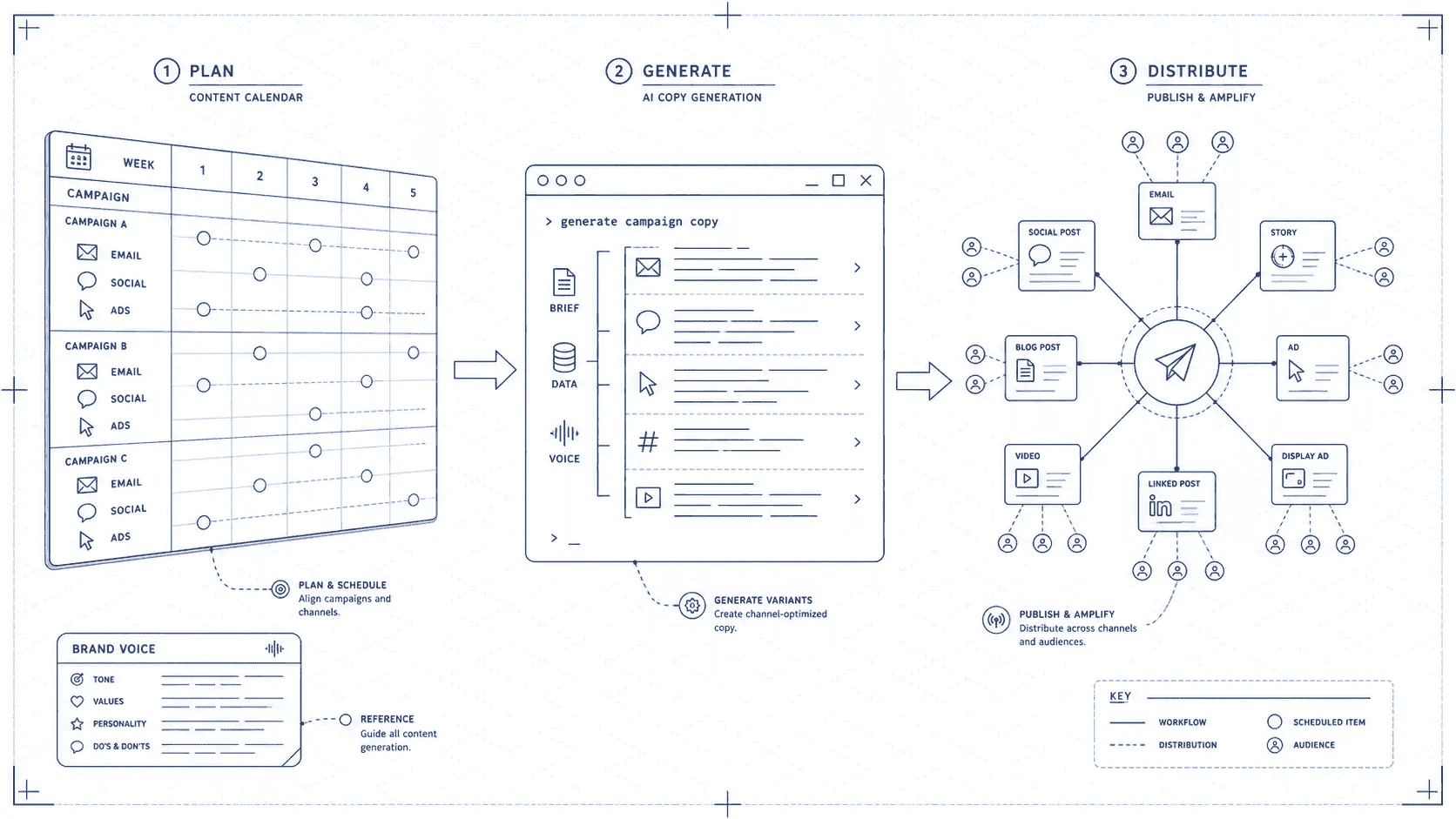
Marketing is volume work. Campaign briefs, content calendars, performance reports, creative briefs, email sequences, social copy, competitive analyses, launch announcements. The output never stops and the channel never stays still.
The 5C Loop works especially well for marketing because marketing documents have high structural consistency — a campaign brief always has the same bones, a performance report always has the same sections, a creative brief always asks the same questions — but the content changes every cycle. That combination is exactly where the loop creates the most leverage.
This page is the marketing spoke of the 5C Loop framework. If you have not read the pillar page, start there. This page assumes you know the five steps.
The 5C Loop in marketing language
The same five steps, translated for how marketing work actually flows.
Capture: Pull the raw material. Campaign performance data, research notes, customer quotes, competitive positioning you have observed, the brief from your stakeholder, analytics exports, last quarter's post-mortem. Marketing suffers more from thin Capture than almost any other function — generic input produces generic output. Your audience knowledge, your brand voice, your past top performers: paste them. Claude cannot infer what you know about your customers.
Context: Every marketing output has a specific reader doing a specific thing with it. Your creative brief is read by a designer making something. Your performance report is read by a VP deciding whether to increase budget. Your email sequence is read by a prospect who is skeptical and in a hurry. Name the reader, name their state of mind, name what you want them to do after reading. The more precisely you specify the destination, the more likely Claude gets you there.
Create: Let Claude produce the full draft before you edit. For marketing, Claude handles structure, coverage, and initial language faster than most writers can from a blank page. Your comparative advantage is what Claude cannot access: your brand voice, your audience's specific phrasing, the cultural reference that will land with your community, the tone that has performed before. Let Claude draft. You make it sound like you.
Check: Marketing check priorities are specific. Brand voice first — Claude defaults to competent but generic. Every draft needs a pass for brand alignment before it leaves your hands. Claims accuracy second — Claude can write a statistic that is directionally right but factually wrong. Check every number, every attribution, every product claim. Audience fit third — does this actually sound like something your specific audience reads and shares, or does it sound like marketing?
Compound: Marketing has extremely high document-type recurrence. Campaign briefs repeat every quarter. Email sequences share a structure across different offers. Social copy variations follow the same format across campaigns. After running the loop on any recurring document type, save the Context block — including your brand voice notes, your audience personas, and your tone guidelines. Within two months, most of your document types have a saved starting point. C2 costs you nothing, C1 is mostly copy-paste, and you spend your energy on C4: the edits that make it actually sound like your brand.
Eight use cases, with prompts
1. Campaign brief
The document that aligns creative, content, and paid before a campaign starts.
## CAPTURE

[paste: campaign objective, target audience (personas if you have them),
key message or value proposition, budget range, timeline, channels,
any constraints (brand guidelines, things to avoid), past campaign context]

## CONTEXT

Reader: creative team, content team, and media buyer — reading this before
kicking off their work. They need enough specificity to make independent
decisions without coming back to you. Format: campaign objective (one
sentence), target audience (2-3 sentences), key message (what we want
the audience to feel or do), channels and formats, timeline with milestones,
success metrics, do's and don'ts. Scannable, not prose-heavy.

## CREATE

Write the campaign brief.
2. Creative brief for an asset
The brief a designer or copywriter uses to make a specific piece.
## CAPTURE

[paste: what the asset is (ad, landing page, email, social post), the
campaign it belongs to, the audience it targets, what it needs to
communicate, any brand guidelines, examples of work you like, format
and dimensions if relevant]

## CONTEXT

Reader: designer or copywriter building this specific asset. They need
enough direction to start without asking five follow-up questions, but not
so much prescription that they cannot make creative decisions. Format:
objective (what the asset should make the viewer do), audience (who, in
their words), key message (one sentence), tone (3-4 adjectives with
examples), what to include (required elements), what to avoid, reference
assets (if any).

## CREATE

Write the creative brief.
3. Performance report narrative
The story behind the numbers, written for leadership.
## CAPTURE

[paste: the metrics from this period (impressions, clicks, conversions,
revenue, CPA, ROAS, or whatever applies), targets vs actuals, any major
experiments run and their results, channel breakdown, what changed
vs last period]

## CONTEXT

Reader: VP of Marketing or CMO reading this in a monthly or quarterly
review. They are looking for: are we on track, what is working and why,
what is not working and what we are doing about it, what we need from
them. Format: brief executive summary (3 sentences), performance vs
target by channel, key insights (what the data is telling us, not just
what the data is), what we are changing based on this, what we need.
Confident interpretation, not raw data narration.

## CREATE

Write the performance report narrative.
4. Email sequence
A sequence that moves a prospect from cold to ready without being pushy.
## CAPTURE

[paste: the offer or product being promoted, the audience (where they
are in the funnel, what they care about, what objections they typically
have), the goal of the sequence (trial, demo, purchase), any past email
data on what subject lines or CTAs have worked]

## CONTEXT

Reader: a prospect who is skeptical and busy. They will delete the email
if the first sentence does not earn their attention. Format: [N]-email
sequence. Email 1: problem-first, no pitch. Email 2: insight or education.
Email 3: social proof or case study. Email 4: offer. Email 5: last chance.
Each email should be under 200 words. Subject lines included. One clear
CTA per email. Conversational tone, not corporate.

## CREATE

Write the email sequence.
5. Social copy variations
Multiple versions of a message, each tuned to a specific platform and format.
## CAPTURE

[paste: the core message or announcement, the audience, the campaign or
campaign goal it belongs to, any key assets (image, video, link), brand
voice guidelines if you have them]

## CONTEXT

Reader: a person scrolling their feed, not looking for you. Format:
three variations — LinkedIn (professional, insight-led, 150-200 words),
Instagram (shorter, visual-first, with suggested hashtags), Twitter/X
(punchy, under 240 characters, with a hook). Each variation should feel
native to its platform. Do not make them sound like repurposed versions
of each other.

## CREATE

Write the social copy variations.
6. Competitive positioning analysis
The document that tells you how to talk about your category and your competitors.
## CAPTURE

[paste: your product or service and what makes it different, the competitors
you are being compared to most often, any sales call notes or customer
feedback about how they compare you, your target audience's primary
buying criteria]

## CONTEXT

Reader: sales team, content team, and product marketing — using this to
sharpen how they talk about us. Format: one-paragraph summary of our
position, competitor-by-competitor breakdown (what they are strong at,
where they fall short, how we compare honestly), our differentiation
statement, what to say vs what to avoid saying when competitors come up.
Honest and useful — not a puff piece about why we win everything.

## CREATE

Write the competitive positioning analysis.
7. Launch announcement
The content that makes a product release feel like a moment.
## CAPTURE

[paste: what is launching, what problem it solves, who it is for, what
is genuinely new or interesting about it, any customer quotes or beta
feedback, the channels this will go to (blog, email, social, PR)]

## CONTEXT

Reader: [specify the primary channel audience — existing customers,
prospects, press, or general public]. They care about whether this is
relevant to them, not about your internal effort. Format: for each
channel, write a version tuned to that reader. Blog: 400-600 words,
story-led, customer benefit focused. Email to customers: concise, benefit
first, clear CTA. Social: [see social copy prompt above]. Lead with what
changed for the reader, not what we built.

## CREATE

Write the launch announcement.
8. Post-campaign analysis
The document that makes sure this campaign makes the next one better.
## CAPTURE

[paste: campaign goal, what we did (channels, assets, budget, timeline),
the results against goal, what we observed during the campaign (what
audiences responded to, what fell flat, any surprises), what we would
do differently]

## CONTEXT

Reader: marketing team and leadership, using this to inform the next
campaign. They need: what worked and why (not just what the numbers were),
what did not work and the root cause (not just "performance was below
target"), and specific recommendations for next time. Format: brief
summary, results vs goal, key learnings (3-5 with specific evidence),
recommendations for next campaign. Analytical and specific, not vague.

## CREATE

Write the post-campaign analysis.
Always check claims and numbers
Claude will produce statistics, percentages, and industry claims that sound plausible but may be fabricated or outdated. Before any marketing content is published — especially anything with a number in it — verify the source independently. An unverified stat in a campaign brief becomes a published stat in an ad.
The compound value for marketers specifically
Marketing has very high structural recurrence: campaign briefs repeat every quarter, email sequences share formats across offers, performance reports follow the same sections cycle after cycle. The Compound step has an unusually high return in this environment.
The first time you run the loop on a campaign brief, it takes time. The fifth time, you have a saved Context block with your audience personas, brand voice notes, and channel preferences already loaded. C2 is already done. C1 is whatever this campaign's specific data happens to be.
The most valuable thing to compound in marketing is brand voice. Claude's default output is professional and generic. If you have saved examples of your best-performing copy alongside notes on what made them work — the phrases your audience actually uses, the tone that converts, the angles that land — Claude can approximate that voice. Not perfectly, but close enough that your editing pass is sharpening rather than rebuilding.
What the Check step means for marketing work
Brand voice is first. Claude defaults to marketing-speak. Phrases like "unlock your potential" and "seamlessly integrated" will appear in drafts. Your job in C4 is removing every word that sounds like it was written by a committee and replacing it with language that sounds like your brand actually talks. Read the draft out loud. If it sounds like an ad, rewrite it.
Claims accuracy is second. Never publish a statistic Claude provided without independently verifying it. This is not a distrust of Claude specifically — it is the same rule you apply to any unverified source. Numbers travel fast in marketing. A wrong number in a brief becomes a wrong number in a published case study.
Audience fit is third. Read the draft as your target customer, not as a marketer. Does this speak to what they actually care about? Does the opening sentence earn their attention? Would they share this? Most first drafts answer "what are we saying" but need work on "why would they care."
Where to go next
The pillar page has the full framework and the loop logic: The 5C Loop.
If you are new to Claude Code, start with Foundations to get your workspace set up. The Compound step only works if your Context blocks and brand voice notes persist — the Memory System guide explains how to set that up properly.
New guides, when they ship
One email, roughly weekly. CLAUDE.md templates, workflows I actually use, and the cut-for-length stuff that does not make the public guides. One-click unsubscribe.
Or follow on Substack