Frameworks
5C Loop for Product Managers
The 5C Loop applied to product management work: PRDs, roadmap updates, discovery readouts, stakeholder briefs, sprint reviews, and the eight PM documents where the loop pays back the most.
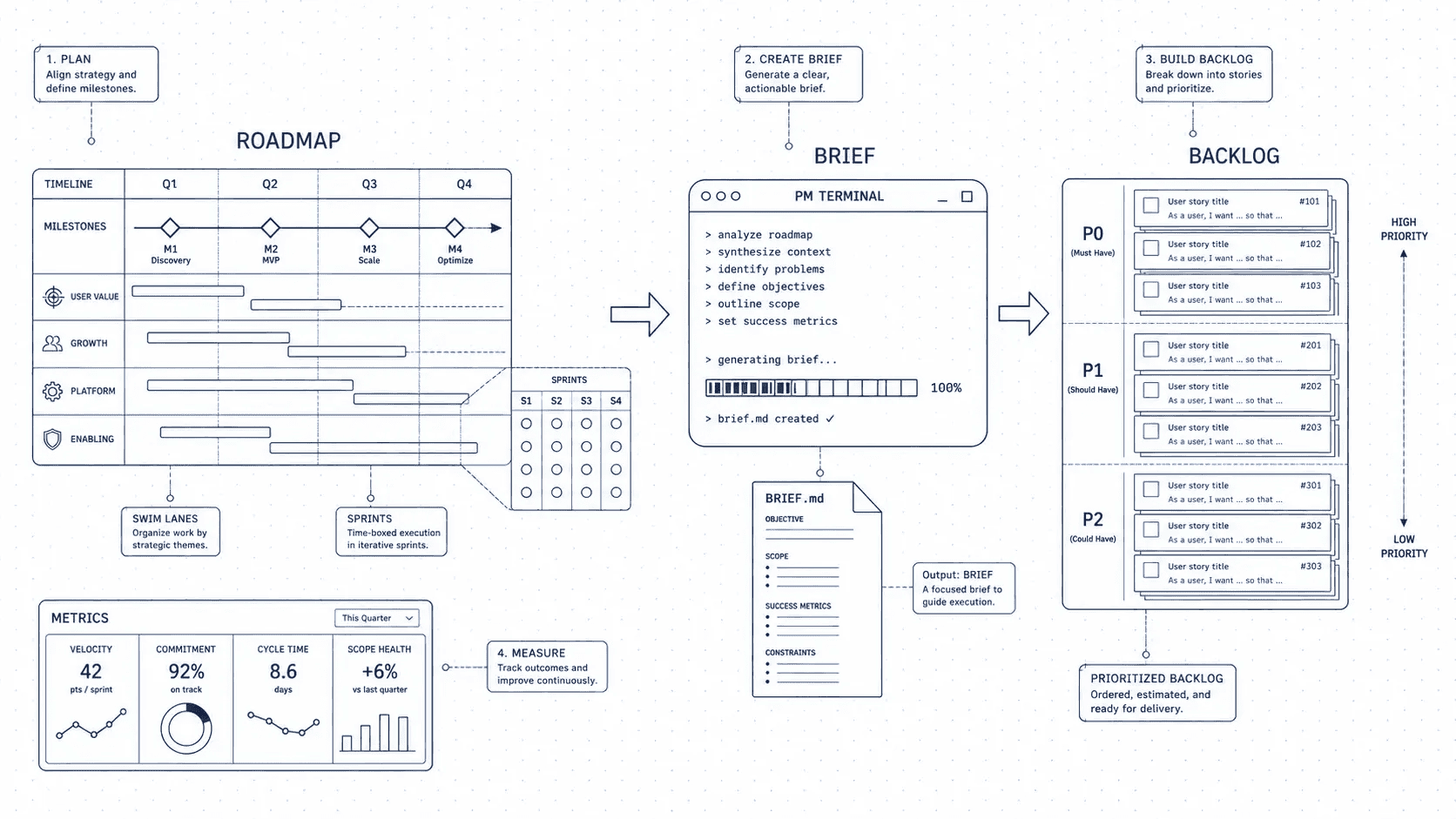
Product management is writing work. PRDs, one-pagers, stakeholder updates, discovery readouts, go-to-market briefs, OKR narratives, sprint reviews. The volume is relentless. The stakes are high: a vague PRD ships the wrong thing. A weak stakeholder update loses the room.
The 5C Loop works especially well for PMs because PM documents have a common structure: context-setting, problem framing, options or analysis, recommendation, next steps. That structure repeats across document types. Once you run the loop on a PRD once, every subsequent PRD is faster.
This page is the product management spoke of the 5C Loop framework. If you have not read the pillar page, start there. This page assumes you know the five steps.
The 5C Loop in PM language
The same five steps, translated for how product work actually flows.
Capture: Pull the raw material. Meeting notes from user interviews, data from the analytics dashboard, the Slack thread where the problem was first surfaced, the competitive research doc, the Jira ticket backlog. The PRD you are about to write is only as good as the evidence you load in. Do not summarize the research — paste the research.
Context: PM documents always have a known reader with a known question. Your engineering lead reads a PRD asking: "is this buildable and in what order?" Your VP reads a one-pager asking: "why does this matter and why now?" Your exec reads a roadmap brief asking: "what are we not building, and are we okay with that?" Name the reader. Name their question. Give Claude that lens before anything else.
Create: Let Claude produce the full draft before you start editing. For PM documents, Claude handles structure and completeness faster than you can type from scratch. Your comparative advantage is the judgment calls: which trade-off to make, what the right recommendation is, what the engineering team will actually push back on. Let Claude draft. You decide.
Check: PM check priorities are specific. Recommendation clarity first — does a reader know exactly what you are recommending and why? Engineering feasibility assumptions second — Claude cannot know what is actually hard to build. Stakeholder sensitivity third — who in the room will object, and is the framing designed to preempt that? Those three questions are the ones only you can answer.
Compound: PM work has the highest recurrence of any knowledge work. Q1 planning becomes Q2 planning. Sprint reviews happen every two weeks. OKR narratives repeat quarterly. After running the loop on any recurring document, save the Context block as a template. Your library builds quarter over quarter. By month six, most of your recurring documents start with C2 and C1 already half-done.
Eight use cases, with prompts
1. Product requirements document
A PRD that engineering actually reads and follows.
## CAPTURE

[paste: user research notes, analytics data, competitive context,
problem statement, any prior tickets or explorations on this topic]

## CONTEXT

Reader: engineering lead and senior engineers. They need to understand
what we are building and why, in enough detail to estimate and sequence.
They will push back on anything underspecified. Format: problem statement,
goals and non-goals, user stories, requirements (functional and non-functional),
open questions, success metrics. Plain language, no marketing speak.

## CREATE

Write the PRD based on the above.
2. Executive one-pager
The one page that gets the meeting or secures the investment.
## CAPTURE

[paste: the problem you are solving, the solution you are proposing,
the evidence that the problem is real, the cost of doing nothing,
what you need from the exec (decision, resources, sponsorship)]

## CONTEXT

Reader: VP or C-suite. They read this Friday afternoon with 12 other
things on their desk. They need to know: what is the bet, why now, what
do you need from them. Format: one page maximum. Problem, proposed solution,
evidence, ask. No bullet points in the body — write it as persuasive prose.
End with a single clear ask.

## CREATE

Write the executive one-pager.
3. Discovery readout
Turning a sprint of research into something that changes priorities.
## CAPTURE

[paste: interview transcripts or notes, survey results, behavioral data,
usability test observations, any quotes worth keeping verbatim]

## CONTEXT

Reader: product team and leadership. Goal: update their mental model of
the user's problem, not just report what we heard. Format: key findings
(3-5 themes, each supported by 2-3 quotes or data points), implications
for our roadmap, recommended next steps, open questions we still need to
answer. Concise. No more than two pages.

## CREATE

Write the discovery readout.
4. Roadmap narrative
The story of what you are building and in what order, and why that order.
## CAPTURE

[paste: the strategic context (where the company is going), the current
backlog and rough priorities, the bets you are making this half, what
you are explicitly not doing and why]

## CONTEXT

Reader: mixed audience — engineering, design, sales, marketing, leadership.
Each group cares about different things. Format: one paragraph of strategic
framing, then the roadmap by theme (not by sprint). Each theme has: what
it is, why it is prioritized now, what success looks like. End with what
is out of scope and why. Confident tone — this is a decision, not a wish list.

## CREATE

Write the roadmap narrative.
5. Go-to-market brief
Aligning the commercial team before a launch.
## CAPTURE

[paste: what the feature does, who it is for, what problem it solves,
how it is differentiated, pricing or packaging details if relevant,
launch timeline, any early customer feedback or beta results]

## CONTEXT

Reader: sales, marketing, and customer success. They need to know how to
position this and what questions they will get. Format: what it is (one
sentence), who benefits and how, what to say vs what to avoid saying,
key questions with suggested answers, where to find more information.
Punchy and scannable — this is a reference doc, not a read-once doc.

## CREATE

Write the go-to-market brief.
6. Sprint review summary
The document that replaces the meeting nobody wanted to sit through.
## CAPTURE

[paste: what we shipped, what we cut and why, metrics from the sprint
if any, what we learned, what changed in our priorities as a result]

## CONTEXT

Reader: stakeholders who were not in the sprint. Goal: they understand
what we shipped, why it matters, and what is next without needing a meeting.
Format: brief context (what we were working on), what shipped (bulleted,
plain language), what we learned, what is next. Maximum one page.
Matter-of-fact tone — no spin, just clarity.

## CREATE

Write the sprint review summary.
7. Stakeholder update
The async update that keeps leadership informed without requiring a meeting.
## CAPTURE

[paste: the initiative, what has happened since the last update, what is
on track vs at risk, any decisions that need to be made, blockers]

## CONTEXT

Reader: a VP or director sponsor who checks in monthly. They want to know:
are we on track, is there anything I need to unblock. Format: one paragraph
of status (green/yellow/red with one sentence of explanation), what happened
since last update (3 bullet points max), what is next, what I need from you
(if anything). Short. They will not read past the third paragraph.

## CREATE

Write the stakeholder update.
8. OKR narrative
The quarterly document that explains what you are optimizing for and why.
## CAPTURE

[paste: the objectives you are proposing, the key results attached to each,
the rationale for each objective (why this, why now), any context from
last quarter's performance]

## CONTEXT

Reader: leadership team in OKR planning. They will question whether these
are the right bets, whether the key results are measurable enough, and
whether this connects to company strategy. Format: for each objective —
one sentence statement, two sentences of rationale, then the key results
with targets and measurement method. Ends with what you are deliberately
not prioritizing this quarter.

## CREATE

Write the OKR narrative.
PRD check priority
Always verify the assumptions Claude makes about technical constraints. Claude cannot know that your auth system makes a particular user flow impossible, or that a specific API call has a 2-second latency that changes the UX approach. Check every technical implication before sharing with engineering.
The compound value for PMs specifically
Product managers have the most to gain from the Compound step because PM work is structurally recursive. OKR planning happens every quarter. Sprint reviews happen every two weeks. Discovery readouts follow the same structure every time.
The investment is front-loaded: running the loop carefully the first time, then saving the Context block as a template. The payback is recurring: every subsequent run of that document type starts with C2 already done, and C1 is mostly copy-paste from whatever input you have that week.
After six months of this, most of your recurring PM documents take 20 minutes instead of two hours. The time shifts from writing to reading: C4 gets more attention because you have more time for it. That is where PM quality actually lives — not in the first draft, but in the judgment call about what needs changing.
What the Check step means for PM work
Recommendation clarity is first. Every PM document should end with a reader knowing exactly what you are recommending and what you want them to do. Claude will often produce a document that is clear on the problem but soft on the recommendation. Check that the ask is explicit.
Feasibility assumptions are second. Claude produces requirements based on what you gave it in Capture. It cannot know that your data model makes a particular feature architecturally expensive, or that the mobile team is already at capacity. Read every requirement through an engineering lens before it goes to the team.
Stakeholder sensitivity is third. Some roadmap decisions have political history behind them. A feature that was previously killed by a different VP. A dependency on a team that has been unreliable. A trade-off that implicitly de-prioritizes someone's initiative. Claude cannot know any of this. You do. Check the framing before it lands.
Where to go next
The pillar page has the full framework and the loop logic: The 5C Loop.
If you are new to Claude Code and still setting up your workspace, the Foundations section covers the basics before you get into task-specific use.
PMs doing this at scale should also read the Memory System guide — the Compound step depends on having a working memory setup where your Context blocks persist between sessions.
New guides, when they ship
One email, roughly weekly. CLAUDE.md templates, workflows I actually use, and the cut-for-length stuff that does not make the public guides. One-click unsubscribe.
Or follow on Substack